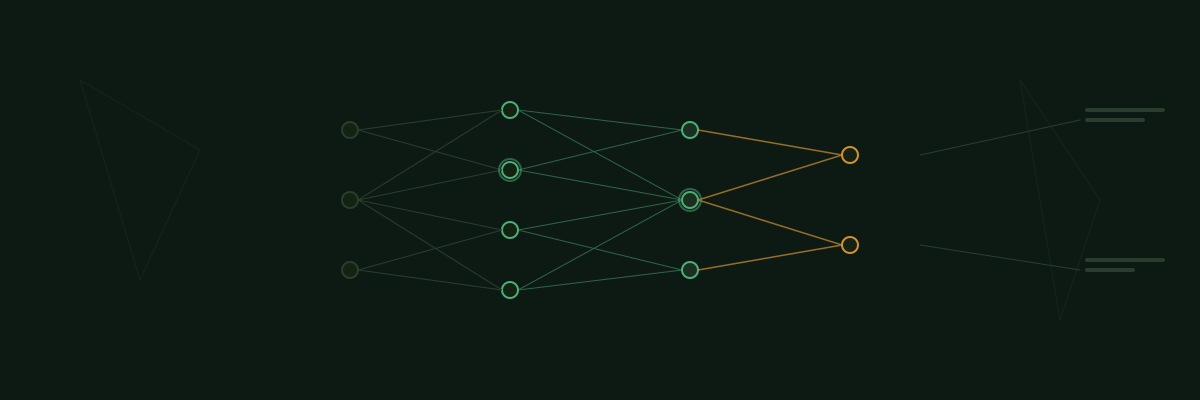
Neural Networks and Grassmann Algebra: Strap in.
I write for business people, some may think that Grassmann Algebra is a new type of craft ale.
If you are a physicist or mathematician save yourself the frustration of my simplification and read the paper here>

For the rest of us.
What’s the Big Idea?
Alright, imagine you’re building a super-smart robot brain-something like Iron Man’s J.A.R.V.I.S. or R2-D2, or if you are old HAL but even cooler.
To make it smart, you need a neural network-a kind of artificial brain made up of tiny, simple parts that work together to solve problems.
Well this is on the way, we are already using neural networks and tensors as you may have heard but to get to true Jarvis reasoning power we will probably need to move past LLM’s - (Large Language Models).
Scientists are now using super fancy math (Grassmann Algebra, if you want to impress your teacher) to make these AI brains even more complex in their reasoning.
We are talking full on J.A.R.V.I.S - strap on your best Ironman suit.
This paper dives into how this math may work and why it might change the future of AI.
So, let’s break it down in a way that doesn’t make most brains melt.
Mine is already mush.
Why Do We Need New Math for AI?
Think of an AI brain like a gigantic LEGO tower.
Each LEGO block is a small decision, and together, they create a working system.
Traditional AI is like stacking LEGO blocks in a square grid—it works, but it can be clunky.
Grassmann Algebra is like having LEGOs that can magically combine in crazy new ways—stacking, twisting, and transforming into new shapes!
It lets AI make sense of patterns that would normally take forever to compute.
Let’s lear this up, before its rudely highlighted in comments.
1. Lack of Empirical Validation
The paper focuses heavily on the mathematical formalism but does not provide empirical results or practical benchmarks demonstrating how this approach improves real-world AI performance.
Without numerical experiments or comparisons against traditional deep learning methods, it’s hard to assess its real-world viability.
We are talking about ideas and futures not working code - not just yet.
2. Complexity of the Approach
Grassmann algebra and its associated mathematical constructs (e.g., quantum idempotents, Clifford algebras) are highly abstract and complex.
This may make implementation computationally expensive and difficult to integrate into existing AI frameworks. (but yay - not Quantum - we will break this down in a moment)
The paper does not discuss how feasible it would be to implement this in standard AI toolkits and it may well be likely that it will require new frameworks and software for us to use it.
3. Limited Explanation of Advantages Over Existing Methods
While the paper claims that using Grassmann algebra can improve AI, it does not explicitly compare its method against other advanced algebraic approaches in AI, such as Lie groups, tensor networks, or geometric deep learning.
If history teaches us anything, we should know that this method may not provide a unique advantage, but does need to be on the radar of math minded AI designers.
4. Theoretical, Not Practical
The discussion remains largelytheoretical, without concrete examples of how this would work in an actual machine learning task.
The paper provides “only a description of the basic operations and transformation” but does not go deeper into practical applications.
So again - Skunkworks type ideas at this point.
But possibly not for Quantum, we are almost there keep reading!
5. Potential Computational Overhead
Grassmann algebra involves anti-commuting variables, which may introduce additional computational overhead when applied to real-world AI tasks.
The paper does not discuss efficiency concerns or whether using this approach would slow down neural networks compared to existing matrix-based methods.
Enter Grassmann Algebra: The Superpower of Math
Grassmann Algebra is a special kind of math that deals with objects that don’t follow normal rules. For example:
Anti-commuting variables – In normal math, if you multiply 3 × 4, it’s the same as 4 × 3 - Duh everyone knows that.
But in Grassmann Algebra, some numbers change when swapped!
Imagine if putting your left shoe on before your right shoe gave you super speed.
Exterior products – Instead of regular multiplication, numbers mix in strange new ways, creating new dimensions of information.
When I say new dimensions of information, I mean mathematical dimensions - not the parallel universe where I have a six pack and lots of money.
Think of mixing two colours and getting a completely unexpected third colour.
🔹 Fermions and Quantum Links – In physics, tiny particles called fermions also follow these weird math rules.
So, Grassmann Algebra is like a secret language of the quantum world!
What Does This Have to Do with Neural Networks?
AI learns by recognising patterns, and sometimes, those patterns are super complicated.
Traditional AI struggles when things get too messy—like trying to solve a maze with invisible walls - we covered how you can use Quantum Machine Learning to crunch data without all of the data, here.
Grassmann Algebra gives neural networks a new way to see the maze, spotting paths and connections that a regular AI would miss.
This could lead to faster learning, better predictions, and even AI that understands human reasoning in a deeper way.
How It Works: The Short Version
Instead of regular numbers, Grassmann Algebra uses special variables (let’s call them “math ninjas”). These ninjas follow unique rules, helping neural networks:
✅ Find hidden relationships (like Sherlock Holmes spotting clues no one else sees)
✅ Process data more efficiently (faster AI that doesn’t drain your phone in seconds)
✅ Understand geometry better (helpful for robots, self-driving cars, and more!)
Where Can This Go?
Imagine an AI that can:
🚀 Predict diseases before symptoms even show up
🚗 Drive your car in a way that’s 100% safe
🎨 Create art that feels truly human
By using Grassmann Algebra, AI could go way beyond what we think is possible today.
A) Grassmann Algebra is Naturally Quantum-Friendly
Grassmann algebra deals with anti-commuting variables, which behave similarly to fermions in quantum mechanics.
Since quantum computers manipulate qubits and often use fermionic algebra in simulations (like in quantum chemistry or condensed matter physics), Grassmann structures align well with how quantum systems work.
🔹 Quantum Bits (Qubits) and Grassmann Variables
- In classical computing, we use matrices and real numbers.
- In quantum computing, we often use Clifford algebra, Grassmann algebra, and Lie groups to describe quantum states, entanglement, and operators.
B. Efficient Representation of Quantum States
Quantum systems require high-dimensional spaces to represent states.
Grassmann algebra provides a compact way to describe entangled states, making it useful for:
✔ Quantum neural networks (QNNs)
✔ Quantum machine learning
✔ Simulating fermionic quantum systems (like electrons in molecules)
👉 In fact, quantum mechanics already uses Grassmann numbers to describe fermionic wavefunctions, so adapting this to quantum AI makes sense.
3. Potential for Quantum AI (QAI)
Quantum computers struggle with classical neural network architectures because they rely heavily on matrix multiplications, which aren’t always efficient in quantum form.
Grassmann algebra offers a different perspective:
✔ It represents multi-dimensional logic compactly.
✔ It aligns well with quantum gate operations.
✔ It could help reduce computational complexity in quantum AI models.
💡 The Big Idea? Grassmann-based AI models could be more natural for quantum hardware than traditional deep learning, potentially unlocking new quantum AI architectures for AI.
Sentience? **Self-aware AI? -**I wont speculate, but potentially these types of advancement allow us to create layers or neural network that we haven’t even started to consider yet.
4. Current Research and Challenges
Several quantum computing models already leverage Grassmann algebra. For example:
- Fermionic Quantum Computing: Used in quantum chemistry to simulate molecular interactions.
- Clifford Algebra & Quantum Gates: Related to quantum error correction and fault-tolerant quantum computing.
- Quantum Boltzmann Machines (QBMs): These use algebraic structures similar to Grassmann to learn probability distributions.
🚨 Challenges?
- We still don’t have a direct, efficient way to implement Grassmann-based AI on quantum hardware.
- Quantum AI is still in early stages, and bridging it with advanced algebra requires new algorithms.
- Grassmann variables aren’t native to quantum circuits yet—so practical implementation might need new quantum gate designs, or different types of Quantum Tech.
Final Verdict: Quantum + Grassmann Algebra?
Very Likely! 🚀
Grassmann algebra is mathematically well-suited for quantum AI, but it’s not yet fully integrated into quantum computing hardware. T
The next big step?
Developing quantum algorithms that can leverage Grassmann structures efficiently.
I am 110% sure that that is already underway somewhere.
Final Thought: The Future is Terrifyingly Awesome, and Awesomely Terrifying.
AI is already changing the world, but new math could make it smarter, faster, and more powerful than ever.
Grassmann Algebra might sound fancy, but at its core, it’s just a better way to organise information—and that could lead to some mind-blowing breakthroughs!
The pace of technological advancement in both AI, Quantum and Cybersecurity continues to bamboozle my little mind.
The more I understand the more I am convinced we are heading down this route like an out of control freight train without breaks, pushing forward technological innovation with little understanding in the way of societal impact.
Without being dramatic, the new advancements in QAI theory and the potential impacts could mean a level of intelligence in AI that we can’t quite comprehend yet.