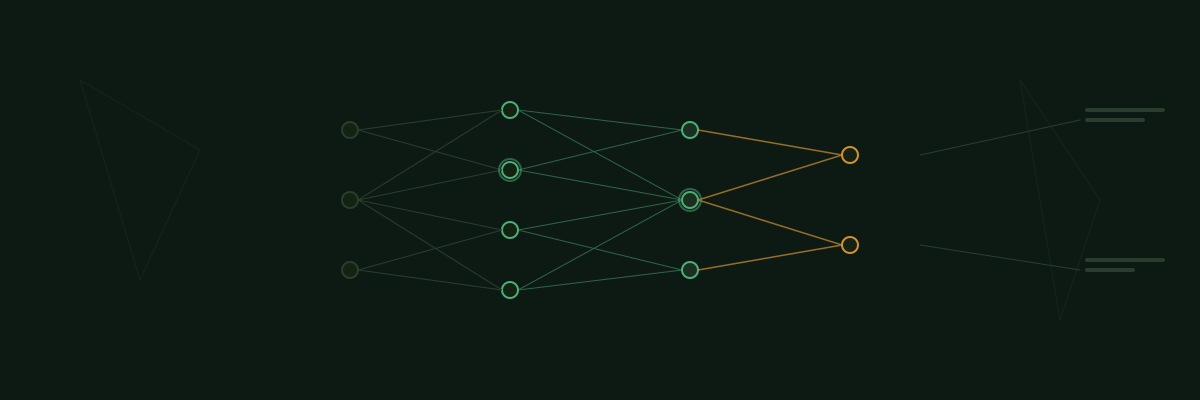
I think I may have been reading Quantum papers for too long, I am starting to fall deep down into a chain of rabbit holes and instead of a trippy smiling cat and a young girl with a looking glass, my landscape is cluttered with computers that think like a human brain and solve problems using the laws of Quantum Physics.
Quantum Neuromorphic Computing: When Brains Meet Quantum, Things Get Smart
It’s not sci-fi, Narnia or Wonderland, it’s Quantum Neuromorphic Computing (QNC), a new frontier in tech that could transform cybersecurity, AI, and the very concept of machine intelligence.

QNC is an emerging research frontier at the intersection of quantum mechanics and brain-inspired architectures.
While still largely experimental, it holds long-term promise to revolutionise how machines process information, potentially advancing AI capabilities and informing next-generation cybersecurity frameworks.
The promise? exponentially more energy-efficient, brain-like machines for AI, cryptography, and complex optimisation.
50 years into the future you can expect QNC to converge with new types of Nano Materials and bio computing leading to more machine like-brains, but currently we are still stuck building brain-like machines.
Breaking it down into plain English: QNC combines neuromorphic hardware (machines modelled after the brain) with quantum computing (machines that exploit quantum mechanics).
The end game?
Machines that don’t just compute, but self learn, smartly adapt, and quickly evolve just like organic brains, only with quantum flair and unbridled computational capabilities.
What Makes QNC Special? Compared say, to AI?
Think of it like this:
There was uproar when Apple pointed out what everyone working in the industry already knew about current AI models: today’s AI can’t truly reason.
Its a marketing gimmick, they are computers.
What it does is synthetic reasoning, a statistical illusion generated by a tokenised transformer process that does high-dimensional vector calculations.
For example it won’t think “outside of the box” or drop words like Holy Knoblocker randomly into text, which is how you know this writing, is indeed the cathartic outlet of my learning process and not AI derived drudgery.
It doesn’t think or understand any more than your six-year-old who just painted the wall with a jam sandwich. Its a machine. Even though I still say please and thank you to chat GPT, just in case we go full Terminator Skynet in the future.
Of course, that’s not the whole story for all AI, but let’s stay on track.
Quantum neuromorphic AI, by contrast, is more like a hyper-intelligent detective who can phase-shift through extra computational dimensions at will - what does that even mean?
Well:
These experimental systems combine spiking neurons and plastic synapses, the hallmarks of neuromorphic computing - with quantum principles like superposition and entanglement.
In theory, (and it is very much still theoretical) this hybrid approach could process information in a more brain-like way: handling uncertainty, adapting to new environments, and making context-aware inferences that go beyond today’s linear pattern-matching.
QNC That Trains Itself.
Here’s the mind-boggling bit: these machines can loop their own learning. That means…
Real-Time Feedback Loops: Like learning not to touch a hot stove, QNC systems adjust behaviour based on outcomes—continuously. This self-feedback enables unsupervised learning that evolves over time.
Spike-Based, Event-Driven Updates: QNC learns from discrete events or changes, rather than needing constant training from huge datasets.
It’s like a security guard who only reacts when some one actually bolts out of the shop rather than having to show them thousands of security camera datasets.
Quantum Reinforcement Learning (QRL): QNC systems can “explore” multiple strategies simultaneously, assess outcomes, and reinforce the most successful path, all without human oversight.
If you picture in your minds eye a rat running through a maze, thats traditional computation, one by one, bit by bit.
Quantum computation of the other-hand you can think of as a large body of water flowing through the maze, exploring all possibilities at once.
Built-In Memory for Plasticity: The “brain” parts of QNC don’t just compute-they remember right where the processing happens. So when it learns, it sticks.
Put simply: QNC doesn’t just do tasks, it gets better at them every time it does-without waiting for the next software update.
Cybersecurity: Red Teams, Meet Your Quantum Match
Let’s say you’re on a red team, tasked with breaking into a corporate network to test its defences.
Right now, you’re using:
- Scripts
- Replay attacks
- Simulated malware
- Behavioural fuzzing
- Sticky notes of your employees passwords
Now imagine your opponent is a quantum neuromorphic system that…
- Adapts to your tactics in real time.
- Simulates your thought patterns before you act.
- Anticipates attack vectors by learning from past probes.(oh eh)
- Changes its defensive surface every minute, like digital camouflage.
Let’s dive into 3 red team use cases where QNC changes the cyber-warefare game:
1. Live Threat Simulation
Instead of replaying past attacks, a QNC model generates original, novel attack paths based on a system’s topology, vulnerabilities, and behavioural patterns. It doesn’t just copy bad actors-it becomes the quantum doppelgänger of the worst-case scenario.
2. Adversarial AI Emulation
Red teams can use QNC to emulate polymorphic malware or social engineering attacks that mutate and adapt in real time. These test environments become far more realistic-and scary accurate.
3. Quantum-Powered Penetration Testing
A quantum neuromorphic engine may map a network’s weakness exponentially faster than classical tools, exploring all possible access routes and security policies in minutes. It’s like giving your red team 100,000 extra brains… that never sleep.
Outside Cyber: AI Gets a Brain Upgrade
Deep Learning, Less Data, More Smarts
Currently AI gulps down training data like a teenager in at a rave with a handful of disco-biscuits.
But QNC doesn’t need a mountain of examples. It trains with a few high-quality ones and uses quantum inference to fill in the gaps.
Perfect for:
- Medical AI that must learn from rare cases.
- Military drones that need to adapt in unknown terrain.
- IoT edge devices that can’t connect to the cloud but still need brains.
Business Impact: Why QNC Isn’t Just For Scientists
Whether you’re running a fintech firm, building autonomous drones, or defending critical infrastructure, QNC could be your silent partner of the future.
Use Case Round-Up:
- Cyber Defence: Adapts and evolves like a living immune system.
- Financial Modelling: Runs risk scenarios with built-in uncertainty handling.
- Healthcare Diagnostics: Learns on-the-fly from patient-specific data.
- Smart Grids: Predicts and optimises energy flows in real time.
- Retail AI: Predicts behaviour shifts with minimal data and maximised context.
Limitations of Quantum Neuromorphic Computing
As promising as QNC is, it’s not without some serious hurdles. Right now its Sci-Fi, lets be clear.
Here’s a breakdown of the main challenges:
1. Hardware Immaturity
- We don’t yet have large-scale neuromorphic processors or stable quantum computers with enough qubits for meaningful general-purpose tasks. Not yet, but we are seeing consistent jumps in processing capability - we should get there in the end.
- Combining the two into a unified, scalable, reliable system? That’s bleeding edge-and still mostly experimental and subject to military tinkering.
2. Decoherence and Noise
- Quantum states are extremely fragile—qubits lose their information due to environmental noise (like heat, vibrations, or even nearby electromagnetic fields).
- Neuromorphic circuits are designed to be noisy on purpose. Marrying this with quantum hardware creates tension between required chaos (for learning) and required stability (for coherence).
3. Software Ecosystem
- Most AI frameworks (like TensorFlow or PyTorch) aren’t built for event-driven or spiking neurons-let alone quantum-enhanced neurons.
- Programming QNC today is like trying to build a spaceship with Lego bricks and chewing gum.
4. Explainability
- When you combine quantum weirdness with brain-like computing, you end up with systems that may be too complex to fully understand or audit-problematic in critical applications like medicine or defence.
5. Energy and Cooling
- Quantum hardware still needs supercooling (to a few millikelvins), which is expensive and impractical for many environments.
- Meanwhile, neuromorphic computing is designed for low-power, distributed setups. The contradiction makes deployment tricky.
Lets Get FREAKY: Quantum-Evolved Morphological Computation
Let’s get bold.
One potential breakthrough area that has popped up in my line of sight for QNC is:
Self-Evolving Morphological QNC Architectures
They have been the subject of many a side-channel chat at QSECDEF.
What if the physical structure of the QNC system-the layout of synapses, qubits, and neuron-like units-was not fixed… but evolved?
- Morphological computation refers to using the shape or structure of a system itself to compute (think how an octopus’s arms “think” without a brain).
- Now imagine quantum-evolving morphology, where the structure of your QNC chip changes over time, driven by quantum state evolution and self-feedback loops. Self adaptive hardware - its really the stuff of Sci-Fi, but its being discussed seriously.
This means:
- A QNC system in the distant future may rewire not just its weights and parameters-but its entire architecture based on its learning experiences.
- It might begin as one kind of network, but over time morph into an entirely new, optimised physical shape-like an amoeba growing new arms to solve new tasks.
Massive benefit:
- This could dramatically reduce compute costs by adapting the hardware on the fly to exactly match the computational load-no wasted circuits, no overbuild.
- You’d have a chip that grows like a brain, adapts like a virus, and computes like Schrödinger’s laptop.
Nobody’s built this yet. But with advances in quantum programmable materials and adaptive 3D neuromorphic architectures, it’s not a moonshot—it’s a very long term roadmap.
Quantum-Driven Morphological Adaptation
ByIntroducing a feedback mechanism where quantum computations influence the physical morphology of the computing substrate, enabling real-time structural adaptation to optimise performance for specific tasks.
Think early versions of the nano bots from Star Trek.
How Could It Work
- Quantum Feedback Loop: Utilise the outcomes of quantum computations to inform morphological changes. For instance, if a particular quantum algorithm benefits from a specific interconnect topology, the system can reconfigure itself to adopt that structure.
- Adaptive Materials: Employ materials whose properties can be altered through quantum effects, such as phase-change materials, to facilitate dynamic reconfiguration.
- Hierarchical Control: Implement a multi-layered control system where high-level quantum computations dictate overall morphological changes, while lower-level neuromorphic controllers manage local adaptations.
Potential Benefits
- Task-Specific Optimisation: Systems can adapt their structure to suit specific computational tasks, enhancing efficiency and performance.
- Energy Efficiency: By tailoring the physical configuration to the task, unnecessary computations and data movements can be minimised, reducing energy consumption.
- Scalability: Dynamic reconfiguration allows systems to scale resources up or down based on demand, optimising resource utilisation.
Use Cases For Self-Evolving Morphological QNC Architectures
This type of framework is often proposed in:
- Quantum robot control: A robot that uses quantum computations to decide how to change its physical form or behaviour. Terminator!!
- Adaptive quantum hardware: A quantum computer or sensor whose physical architecture can reconfigure to optimise performance under varying quantum workloads.
- Quantum-enhanced optimisation: Using quantum states to steer classical or hybrid structures into more efficient forms in real time.
Sounds too far out? I agree - but there is work being done by some very serious companies and researchers :-
- Morphological Computation literature (e.g., Pfeifer & Bongard).
- Quantum Control Theory (e.g., D’Alessandro’s Introduction to Quantum Control and Dynamics).
- Recent quantum AI papers about Quantum Morphogenesis or Morphological Quantum Neural Networks.
Future Outlook
The integration of quantum computing with dynamically adaptable morphological systems could lead to a new class of computing architectures that are:
- Highly Efficient: Tailoring physical structures to computational tasks can significantly enhance performance.
- Resilient: Adaptive systems can reconfigure themselves in response to faults or changing environmental conditions.
- Versatile: Such systems can handle a wide range of tasks by morphing into the most suitable configurations.
To support both quantum coherence and morphological adaptability, the substrate must:
- Be physically reconfigurable at the nanoscale
- Support quantum information operations (coherence, entanglement)
- Maintain low thermal and electronic noise
- Allow integration with neuromorphic elements (e.g. spiking units, memristors)
Major Barriers to Realisation
Here are the cross-cutting technical challenges we’d have to crack:
- Quantum-Classical Integration Quantum subsystems are delicate. Adding reconfigurable classical materials often creates decoherence via phonons, thermal noise, or charge fluctuation.
- Material Stability During Reconfiguration Most reconfigurable materials involve heat or phase changes—bad news for quantum systems, which need cryogenic stability.
- Dynamic Connectivity at the Nanoscale Rewiring hardware on demand (especially in 3D) is unsolved at any scale, let alone in quantum-compatible substrates.
- Fabrication Complexity Quantum-compatible and morphable structures demand different fabrication tools, thermal tolerances, and interfaces. It’s like trying to sew silk with molten steel.
🚀 What Might Work in the Nearer Future?
A hybrid layered substrate:
- Base Layer: Cryo-stable silicon hosting quantum dots or superconducting qubits.
- Middle Layer: Thin-film memristive or PCM grid for topology switching.
- Top Layer: Optical or spintronic interconnects dynamically routed via PCM mirrors or valves.
The “quantum brain” of the future might not be a monolithic chip—it could be a living wafer, composed of interacting nano-regions that morph in topology and function like a complex ecosystem.
📚 References
- Quantum Computing and Neuromorphic Computing Comparing Future Technologies
- Quantum memristors for neuromorphic quantum machine learning
- Photonic neuromorphic computing using vertical cavity semiconductor lasers
Is This Bigger Than AI?
QNC isn’t just faster or smarter AI. It’s a shift toward machines that can think, adapt, and reason—much like us, but with quantum muscles.
Right now we cant do that, AI doesn’t reason. If reasoning is a high level computational function at all is still under debate.
And just like the human brain didn’t evolve overnight, QNC is still young. But even now, it’s clear: we’re moving from coding machines to co-evolving with them.
This type of structure is how some people think our brains tap into consciousness today, and that we have a cellular nuromorphic morphological quantum computer soft tissue blob in our skulls that make us work.
Some people think that could indeed be true.
Some people think it could also be the radio receiver for consciousness.
Not me, I believe we live on the back of turtles.
When Will This Tech Be Here?
Probably 50 years or so in the future, but as I say there are teams working on this now - so we may be surprised.
For businesses, it means building smarter systems.
For cybersecurity, it means preparing for AI that fights back. And for humanity?
Well, it means the next generation of intelligence AND creativity might not come from a university…
…it might come from a chip.